Protection against bans
Advertising platforms (especially Google Ads) enforce extremely strict moderation rules. Cloaking ensures that moderators only see compliant content, drastically reducing the risk of account and domain suspensions.
In 2026, Google Ads remains one of the most lucrative yet challenging platforms for traffic arbitrage. Moderation has intensified, cloaking detection systems have become significantly smarter, and standard IP databases or basic redirects now lead to rapid account suspensions. Many media buyers frequently encounter "Circumventing Systems" violations and sudden campaign shutdowns just days after launching.
Introduction
This guide explores why traditional cloaking methods fail with Google and how advanced solutions tackle the core issue: navigating the Google Global Cache (GGC) infrastructure.
Core concept
Cloaking is a traffic filtering technology that displays different content to various visitors based on specific parameters, such as IP address, device type, user behavior, traffic source, and more.
In simple terms: at the exact same URL, ad platform moderators and bots are shown a safe, compliant "white" page (Safe Page), while actual target users are directed to the real offer page (Money Page).
Why media buyers use it
Advertising platforms (especially Google Ads) enforce extremely strict moderation rules. Cloaking ensures that moderators only see compliant content, drastically reducing the risk of account and domain suspensions.
Cloaking filters out massive amounts of useless and harmful traffic, including click farms, checker bots (such as Google Safe Browsing), spy services, and low-quality visits.
When accounts and domains survive longer, less money is spent on constant farming, warming up, and testing. This directly boosts ROI, lowers the cost per lead, and allows for confident volume scaling.
The challenge
Google relies not only on its own data centers but also on a massive distributed network called Google Global Cache (GGC)—servers hosted by regular internet service providers worldwide. These IP addresses appear as "residential" or ISP traffic, rather than typical data center ranges.
Advanced services maintain comprehensive lists of these IP addresses, obtained through direct access to a backbone router with a BGP full view from a Tier-1 provider.
Meanwhile, standard cloaking services:
moderators spot the discrepancy, the account gets banned, and the traffic budget is wasted.
Launch process
The Professional plan is highly recommended for serious Google operations, offering unlimited campaigns, API access, maximum protection, and full feature availability.
Within the cloaking dashboard, pre-configured setup templates for Google can be selected. However, before creating a traffic flow, it is crucial to address other essential launch details.
In 2026, a successful Google Ads launch primarily depends on a properly constructed technical infrastructure. If even one link in the chain is weak, Google's system will detect it and ban the entire setup.
Key considerations:
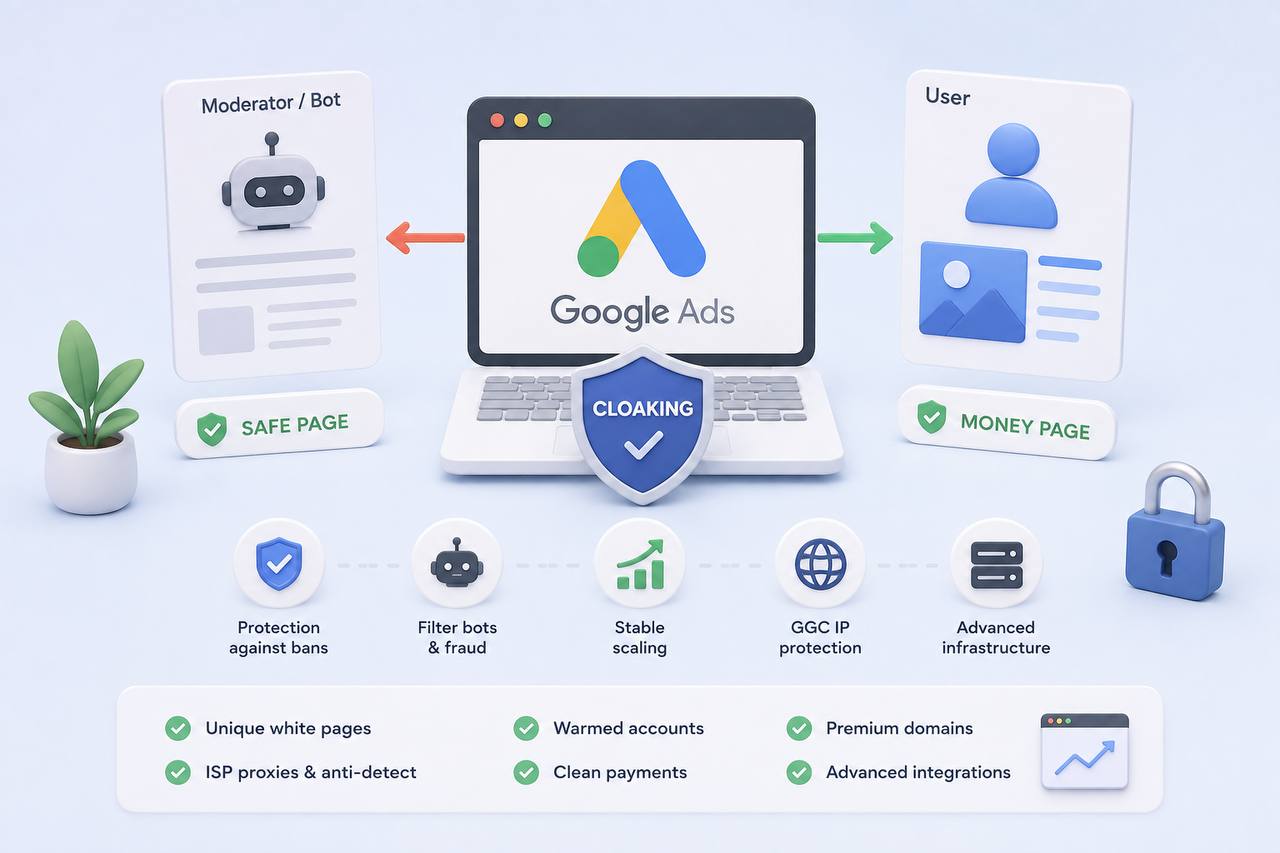
The default settings are optimized for most traffic sources and use cases, meaning cloaking preparation takes minimal time.
The essentials:
There are 5 primary integration methods available:
This is the foundational and most reliable method. The index.php file in the website's root folder is completely replaced with the service's file. The system manages content delivery automatically, showing moderators the white page and target users the offer without altering the browser URL.
Ideal for existing CMS-based websites where the main file cannot be simply deleted. A helper filter.php file is uploaded to the server, and a short line of code is inserted at the very beginning of the existing index file.
Designed for website builders like Tilda or Shopify that do not provide server-side PHP access. The ajax.php file is hosted on any external hosting, its URL is specified in the dashboard, and the generated script is pasted into the page code on the builder.
Native support for this tracker allows the system to operate at the filter level within traffic flows. This enables the utilization of powerful filtering algorithms directly inside the Keitaro interface, eliminating the need to configure cloaking for each domain individually.
Built-in support enables lightning-fast click processing. This integration merges the tracker's detailed analytics with advanced bot and spy-service protection within a single workspace.
Summary 📌
Launching Google Ads campaigns in 2026 requires a strategic approach to bypass strict moderation and advanced detection systems. Cloaking remains an essential tool for protecting accounts, filtering out bot traffic, and ensuring stable scaling. The primary challenge lies in Google’s distributed Google Global Cache (GGC) network, which demands highly accurate IP databases to avoid detection. Success depends on a robust technical infrastructure: unique white pages, quality ISP proxies, warmed accounts, clean payment methods, and premium domains. By following a structured setup process and utilizing advanced integration methods, media buyers can significantly extend the lifespan of their campaigns and maintain consistent performance in a highly regulated advertising environment.